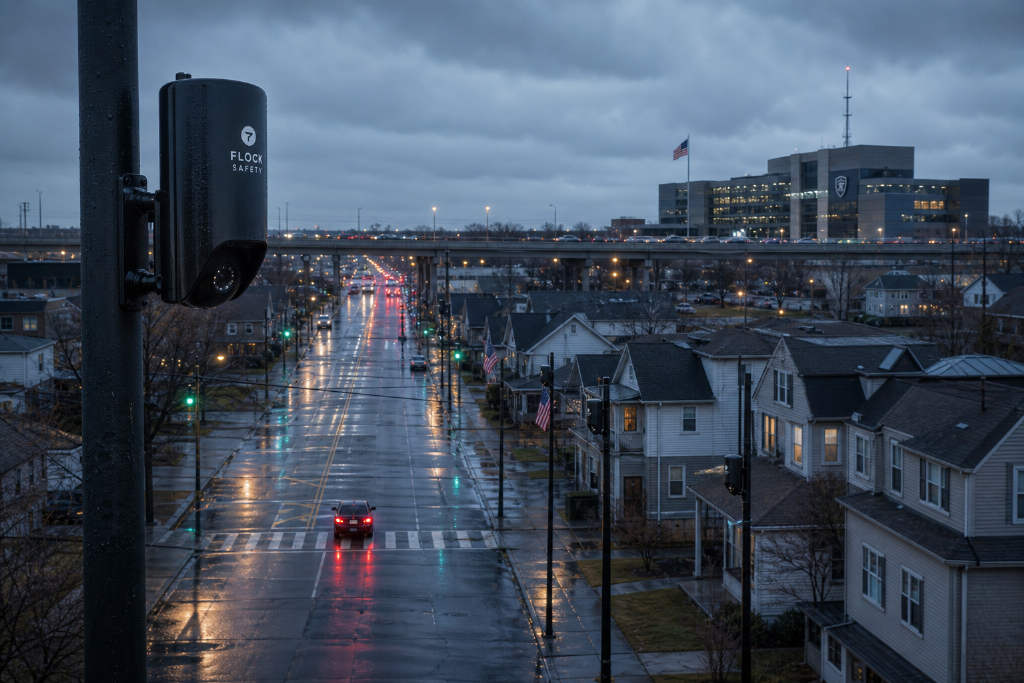
Flock Safety2026-08-20 11:34:16Flock’s AI policing tool can identify drivers without names or plates, report saysFlock Safety, the surveillance company whose camera network spans more than 6,000 U.S. communities, is facing fresh scrutiny after Wired reported that the company has built an AI investigative tool capable of identifying and following drivers using movement patterns alone. According to the report, the system—once called Nightshift and now renamed OS Investigate—was discovered in code pulled from files hosted on Flock’s own site and accessible through its login pages. Flock said the product remains in development and is being tested with a small group of law enforcement partners. Wired described a system that lets officers choose from 69 preset prompts or write their own queries. Some of those prompts reportedly require no name, plate number, or physical description. Instead, an officer can enter a location, a time window, and a behavioral pattern, such as vehicles visiting several retail stores over several days or multiple banks within a week, and the software returns matching people. The report also says the code contains association logic that looks for repeated co-appearance near the same cameras. The disclosure has intensified criticism from civil-liberties advocates, former police officers, and lawmakers. Flock maintains that OS Investigate is separate from its license-plate reader product and says the tool’s features could change before any broader release.690
Ray Dalio2026-07-23 21:35:14Ray Dalio Warns CBDCs Could Erase Financial Privacy, Become Tool of Government ControlBillionaire investor Ray Dalio warns that central bank digital currencies (CBDCs) could enable instant taxation, strict capital controls, and exclusion of dissidents, effectively eliminating financial privacy.560
Iran internet2026-07-23 09:45:15Iran's 35-Day Internet Blackout Leaves Just 1% Connectivity, Citizens Risk Death to Break ThroughIran's nationwide blackout enters its 35th day with connectivity at 1% for over 816 hours. Citizens risk execution using VPNs, Tor and Starlink. Only regime-approved influencers and officials have free access.550
Bitcoin2026-07-03 19:00:14Bitcoin 2026 Conference Frames Self-Custody as a Civil Liberty Worth ProtectingAt the opening of the Bitcoin 2026 Conference, speakers from policy, finance, and technology argued that bitcoin self-custody should be treated as a protected civil liberty rather than merely a personal security preference. The discussion featured Joe Kelly, co-founder and CEO of Unchained, U.S. Congressman Nick Begich, and Zach Herbert, CEO of Foundation Devices, all of whom linked control over digital assets to broader principles of private property, sovereignty, and individual freedom. Begich, who said he began buying bitcoin in January 2013 and lived through the Mt. Gox collapse, argued that the legal concept of private property must extend into the digital realm. He also cited the 1933 confiscation of privately held gold as a historical warning that governments under pressure may seize assets, making self-custody an important defense against centralized confiscation. During the panel, Begich displayed the Bitcoin Act and highlighted language affirming the right of individuals to maintain full lawful control over their bitcoin and other digital assets. Speakers also stressed that legislation is only part of the solution: the self-custody industry must build products that are easier to use without sacrificing security. While Begich acknowledged that 90% of bills never become law, he urged the bitcoin community to contact elected representatives and actively defend these rights.480